
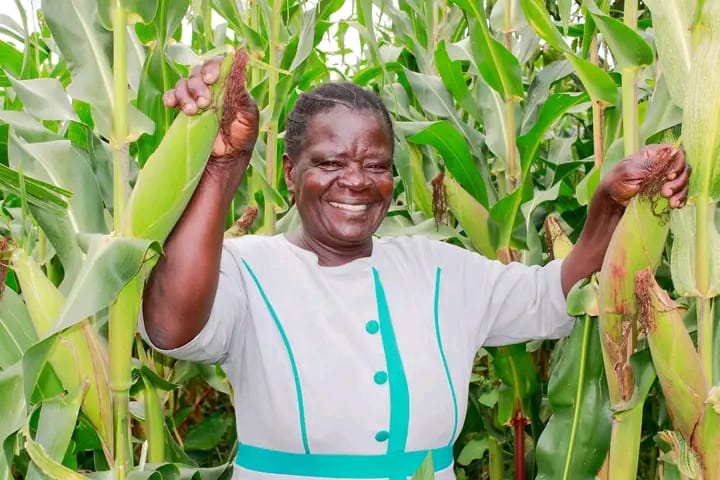
For Regina Nabwire, farming is more than putting food on the table. Her small farm in Bukhayo, western Kenya, has become a source of income, a learning centre for neighbouring farmers and a pathway to a better life for her family.
After retiring from teaching, Regina returned to farming, growing arrowroots, maize and sweet potatoes while keeping bees.Initially, her farm mainly provided food for her household. But everything changed in 2019 when her community selected her to become a Village-Based Advisor (VBA) with FIPS Africa.
Through the programme, Regina received practical training and planting materials, which she used to establish demonstrations and experiment with different farming practices.Her farm gradually became a learning point where neighbours could observe different techniques, ask questions and adopt practices that worked for them.Among the initiatives she introduced were demonstrations involving different maize varieties.
Regina and neighbouring farmers planted small packs of various varieties, compared their performance and selected those that suited their farms and preferences.She also established a brachiaria nursery, making fodder planting materials available closer to farmers in her community.Regina grows Napier grass as well and shares her experience on the tumbukiza method of planting fodder.She has also embraced organic soil fertility practices, using bokashi compost and manure on her maize.
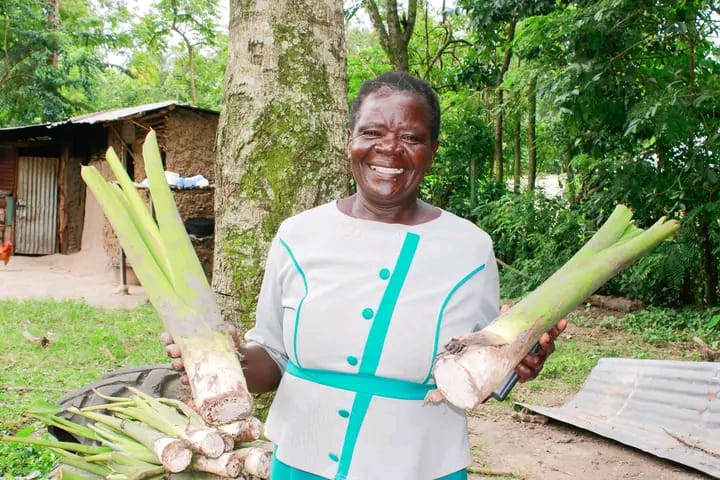
Photo|Regina Nabwire holding arrowroots
“Using bokashi compost and manure has helped me reduce my spending on fertiliser,” she says.
Her livestock enterprise has also started paying off. Regina reports that her cow’s daily milk production has increased from about one to two litres to roughly twice that amount.
She sells part of the milk and reinvests some of the proceeds in animal feed.Today, Regina has expanded her arrowroot enterprise to two acres, supplying planting materials to farmers seeking to establish their own plots.
Her first arrowroot harvest earned her KSh10,000, money that helped her pay school fees and farm workers.Income from her farming enterprises has since enabled her to purchase a plot of land while continuing to support her family.
Her breeding bull has also provided services to about 60 cows in the community, helping neighbouring farmers access breeding services closer to home.Regina says her greatest motivation is seeing other farmers learn from what she has achieved.
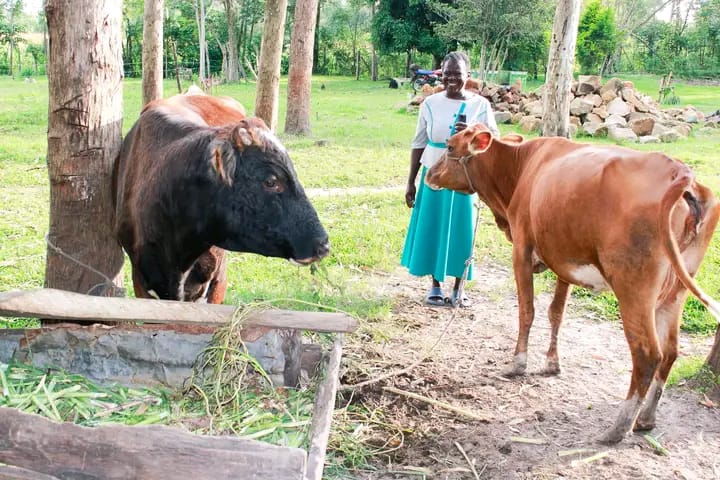
Photo|Nabwire with her livestocks
“My farmers learn from watching me succeed. When they see that I have food surplus, that I can pay school fees and even buy land from farming, they want to follow the same path,” she says.
She now plans to expand her arrowroot enterprise further while helping more farmers establish their own plots.For Regina, the farm has become more than a source of food, it is a demonstration that with the right knowledge, practical support and willingness to experiment, farming can provide both food security and a sustainable source of income.